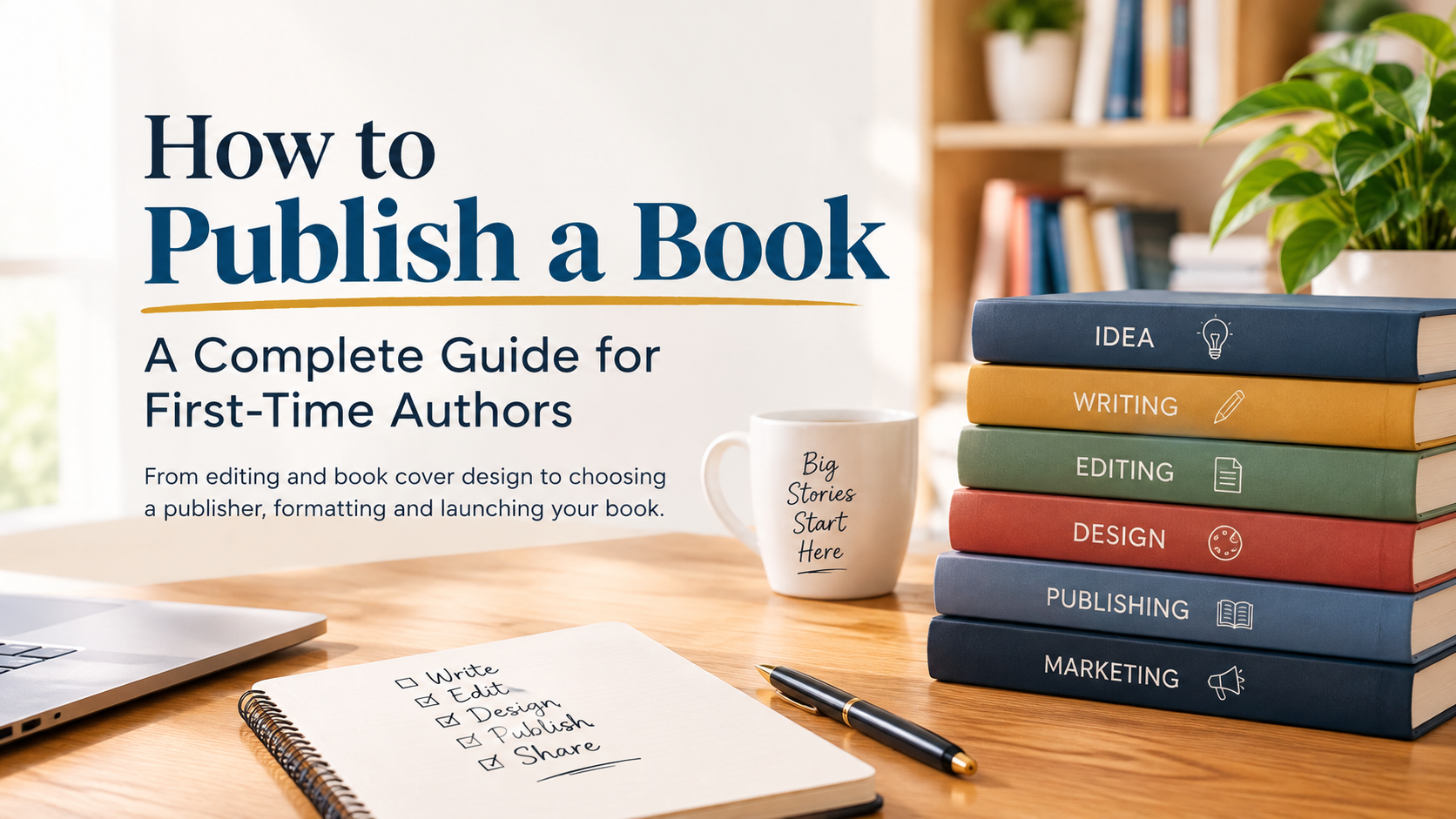
Writing a book is a significant achievement, but finishing your manuscript is only the beginning of your publishing journey. If you are wondering how to publish a book for the first time, understanding the process can help you make informed decisions and prepare your manuscript for readers. From editing and book cover design to selecting a publishing method and promoting your finished book, every stage contributes to its success.
First-time authors often find publishing overwhelming because there are several options, services, and decisions to consider. The good news is that you do not need to know everything at once. With a clear plan and the right support, you can move from a completed manuscript to a professionally published book.
1. Finish and Review Your Manuscript
Before exploring publishing options, make sure your manuscript is complete. Whether you are writing fiction, nonfiction, a memoir, or a children's book, your content should be organized and ready for professional review.
Start by reading your manuscript from beginning to end. Look for gaps in the story, unclear explanations, inconsistent information, repetitive sections, and areas that need improvement. For fiction, pay attention to character development, pacing, dialogue, and plot structure. For nonfiction, check the accuracy, organization, and clarity of your ideas.
It is helpful to take a short break before reviewing your work. Returning with fresh eyes can make it easier to identify problems you may have overlooked while writing.
You do not need to perfect every sentence yourself. The goal is to prepare a complete draft that an editor can evaluate and improve.
2. Choose the Right Book Editing Services
Professional editing is an important step in book publishing for beginners. Even experienced writers benefit from an objective review of their work. An editor can identify issues that authors may miss because they are too familiar with their own manuscripts.
Different types of editing serve different purposes:
- Developmental editing: Examines the overall structure, organization, plot, arguments, and flow of the manuscript.
- Copyediting: Improves grammar, punctuation, sentence structure, consistency, and readability.
- Proofreading: Checks the final formatted manuscript for remaining spelling, punctuation, and typographical errors.
The type of editing you need depends on your manuscript's condition and publishing goals. Some books require substantial structural revisions, while others may need only a detailed copyedit and final proofread.
Investing in suitable editing services helps you present a polished book that meets readers' expectations.
3. Decide Between Traditional Publishing and Self-Publishing
One of the most important decisions for first-time authors is choosing how to publish. The two main options are traditional publishing and self-publishing.
Traditional Publishing
Traditional publishing usually involves submitting a manuscript or book proposal to literary agents or publishers. If a publisher accepts your work, it may manage editing, production, distribution, and some marketing activities under the terms of your agreement.
The process can be competitive and time-consuming. Authors may also have less control over certain creative and business decisions.
Self-Publishing
Self-publishing allows authors to publish their books independently, often through online publishing platforms. Authors typically retain more control over the content, design, pricing, and release schedule, depending on their agreements with service providers and platforms.
However, self-published authors are generally responsible for coordinating production, distribution, and marketing, or paying professionals to handle these tasks.
Neither option is automatically best for every writer. Consider your budget, timeline, creative preferences, distribution goals, and willingness to manage the publishing process before making a decision.
4. Prepare a Professional Book Cover
A book cover is one of the first things potential readers notice. It communicates the book's genre, subject, tone, and intended audience before someone reads the description.
Professional book cover design should reflect the content and appeal to the readers you want to reach. A thriller, romance novel, business guide, and children's book each require a different visual approach.
A strong cover generally includes readable typography, appropriate imagery, balanced composition, and a clear visual hierarchy. It should also remain recognizable when displayed as a small thumbnail on an online bookstore.
Remember that print and digital editions may have different design requirements. A paperback cover typically includes the front cover, spine, and back cover, while an ebook cover usually requires a front-facing image.
Working with an experienced designer can help ensure that your cover looks professional and meets the technical requirements of your chosen publishing platform.
5. Format Your Book for Print and Digital Reading
Book formatting organizes your manuscript into a readable, consistent layout. Good formatting helps readers move through the content comfortably and gives the finished book a professional appearance.
For print books, formatting includes page margins, chapter openings, page numbers, paragraph spacing, typography, and the placement of headings. The final layout must also meet the printer's specifications, including trim size and any required bleed.
Ebooks require a different approach. Text should adapt to different screen sizes and allow readers to adjust font settings where supported. Headings, navigation, images, and paragraph styles must work correctly across compatible devices and reading applications.
Before publication, review the final files carefully. Check chapter order, page breaks, image placement, table of contents links, and any formatting errors introduced during conversion.
Professional book formatting services can help prepare files that meet the requirements of your intended print and digital formats.
6. Select a Publishing Platform or Publisher
Once your manuscript and design files are ready, decide where and how your book will be published.
Online self-publishing platforms can provide access to ebook and print-on-demand distribution. Different platforms have different rules for file specifications, pricing, royalties, territories, exclusivity, and book metadata, so review their current terms before uploading your work.
If you work with a publishing company, ask which services are included in the agreement. Clarify responsibilities for editing, design, formatting, distribution, and marketing. Request a written breakdown of fees, deliverables, timelines, and rights.
Be cautious of promises of guaranteed bestseller status or guaranteed sales. A professional publishing arrangement should clearly explain what services will be provided and what results cannot be guaranteed.
Choose an approach that suits your goals, budget, and desired level of involvement.
7. Write an Effective Book Description and Metadata
Your book description helps potential readers decide whether the book is right for them. It should explain the main premise or benefit, introduce the intended audience, and give readers a compelling reason to learn more.
For fiction, focus on the central conflict, key characters, and the questions that make the story interesting without revealing major spoilers. For nonfiction, explain the problem the book addresses, what readers can learn, and why the subject matters.
Metadata also plays an important role in online discoverability. Depending on the platform, it may include your book title, subtitle, author name, description, categories, keywords, language, and publication details.
Use relevant search terms naturally in your description and metadata. Avoid keyword stuffing or selecting categories that do not accurately represent the book. Relevant metadata helps platforms understand your content and can improve the chances of reaching suitable readers.
8. Set Your Book Price and Publication Date
Pricing affects how readers perceive your book and whether they decide to purchase it. Before setting a price, research comparable titles in your genre, consider your production costs, and review the pricing options available on your publishing platform.
For print books, production costs can affect the royalties you receive. Ebook pricing may follow a different royalty structure. Distribution fees, printing charges, taxes, and platform-specific terms can also influence your earnings.
Choose a publication date that gives you enough time to complete the final checks and prepare your launch activities. Confirm that the book files, cover, description, and metadata are ready before making the book available for purchase.
A realistic schedule helps reduce last-minute mistakes and gives you time to build interest in your upcoming release.
9. Plan Your Book Marketing Strategy
Publishing your book makes it available to readers, but it does not automatically guarantee sales. A practical book marketing strategy helps potential readers discover your work.
Start by identifying your target audience and the places where they search for books or discuss your subject. Depending on your genre and budget, marketing activities may include:
- Creating an author website with information about your book.
- Publishing useful blog content related to your book's topic.
- Building an email list and sharing relevant updates.
- Using social media to connect with potential readers.
- Requesting honest reviews from appropriate readers.
- Exploring bookstore listings, online advertising, and relevant promotional opportunities.
You do not need to use every marketing channel. Choose activities that suit your audience and resources, then monitor which ones generate meaningful engagement and sales.
Marketing should begin before publication where possible and continue after launch. Consistent efforts can help your book reach new readers over time.
10. Complete a Final Review Before Launch
Before publishing, check every part of your book's presentation. Read the proof or review the digital edition, verify the cover and metadata, confirm the price, and check that the selected categories and keywords are relevant.
For print books, order a physical proof when available. This allows you to inspect the paper, cover, margins, page numbering, and overall appearance before making the book widely available.
Also confirm that you own or have permission to use any images, quotations, fonts, and other third-party materials included in the book.
Keep copies of your final manuscript and publication files. Organizing your files makes it easier to correct errors or prepare future editions.